- CFO Playbook
- Posts
- External or In-House Accounting - When to Make the Switch
External or In-House Accounting - When to Make the Switch


Simone Rüschenberg & Ellen Köhler
April 16, 2026

We’re Ellen and Simone. After 36 years in finance, we’re ready to share what textbooks won’t tell you.
💛 Welcome to CFO Playbook – your practical finance insights delivered bi-weekly. The full read will take approximately 5 minutes. Like what you see? Share it! Use the button below.
READ OF THE WEEK
Accounting usually becomes a leadership topic once it starts hurting. Wrong postings. Missed closes. Slow response times. No backup. And the classic CFO frustration: the books are "covered" - but you are not in control.
External accounting is often the right starting point - and for pre-Series A companies, often the only sensible call. Low fixed cost. Fast access to capacity. No need to build from scratch.
But by Series A at the latest, the cracks typically start showing. And at some point, the question changes.
It is no longer: Who can do the bookkeeping?
It becomes: What setup gives finance the control, speed, and quality the business actually needs?
In this Read of the Week
1. The real trade-off: flexibility vs. control
2. Where external accounting breaks first
3. When external, hybrid or in-house works best
4. What AI is changing - and what it isn't
5. The CFO checklist: what to do before you switch
1. The Real Trade-off: Flexibility vs. Control
External accounting works for a reason. You avoid fixed headcount on payroll that isn't fully utilised. You get trained people fast. You do not need to build the function from day one.
But be careful with the cost argument. External fees can scale faster than expected - and once complexity rises, the hourly or project costs often surprise. The smarter framing isn't "cheaper." It's risk-adjusted smarter for the early stage.
The trade-off is structural: you buy capacity - not ownership.
An external accountant's job is to keep the books technically correct and compliant. A CFO needs more: fast close, clean reporting, reliable cost allocation, and real confidence in the numbers. That is where the gap starts.
External gives flexibility. In-house gives control.
Once finance becomes a steering function - not just a reporting function - control starts to matter more.
💡 What most teams underestimate: accounting is the input layer for reporting, forecasting, audits, and board packs. Quality degrades upstream long before anyone notices downstream. |
2. Where External Accounting Breaks First
Weak setups rarely collapse all at once. They erode - in small, recurring ways that quietly drain CFO bandwidth. The graphic below shows the five most common warning signs.

A structural issue particularly common in DACH: external accounting typically sits inside a tax advisory firm. That shapes the entire setup. The chart of accounts, the coding logic, the P&L structure - all optimised for statutory compliance, not for management decisions. The same accounts then get used for management reporting, but the underlying structure was never built for that purpose. Cost centers are incomplete. Account groupings don't map to how the business actually runs.
Getting to a clean, useful P&L often requires significant manual mapping and rework every month. AI is making that mapping easier - but it does not fix the structural mismatch.
None of this stays in the accounting function. It hits reporting quality, creates close rework, and erodes trust in the numbers - pulling CFO attention into firefighting instead of forward-looking work.
The honest question: are the same frustrations returning despite escalation and process cleanup? If yes, it is probably no longer a provider problem. It is a model problem.
💡 A useful test: if your first instinct is always to double-check the numbers before using them, trust has already eroded. That is a model problem, not a personnel problem. |
3. When External, Hybrid or In-House Works Best
There is no universal winner. The right answer depends on complexity, pace, and what finance is expected to deliver - not on a single milestone.
External works well when:
Structure is simple - one entity, one country
Transaction volumes are manageable
The core need is compliant bookkeeping, not fast reporting
In-house becomes more attractive when:
Close speed matters for board or investor timelines
Multi-entity or international complexity increases
Non-standard topics require real business context
The CFO needs direct control over execution and quality
For VC-backed companies, end of Series A is often the clearest trigger - reporting gaps, slow close, and misaligned books start falling on the CFO's desk at exactly the moment the business needs finance to step up. But the timing varies. Some hybrid setups work well beyond that point, particularly in other markets where external providers are less focused on statutory accounting. The real signal is not the funding round - it is whether the current setup is still giving finance the control and speed it needs.
The hybrid model is often the smartest next step: Bring the day-to-day books in-house. Keep the external tax advisor for VAT filings, annual tax returns, and statutory compliance - that is what they are actually good at, and that part of the relationship often makes sense to maintain long-term even as you build internally. Own the management accounting. Outsource the compliance work.
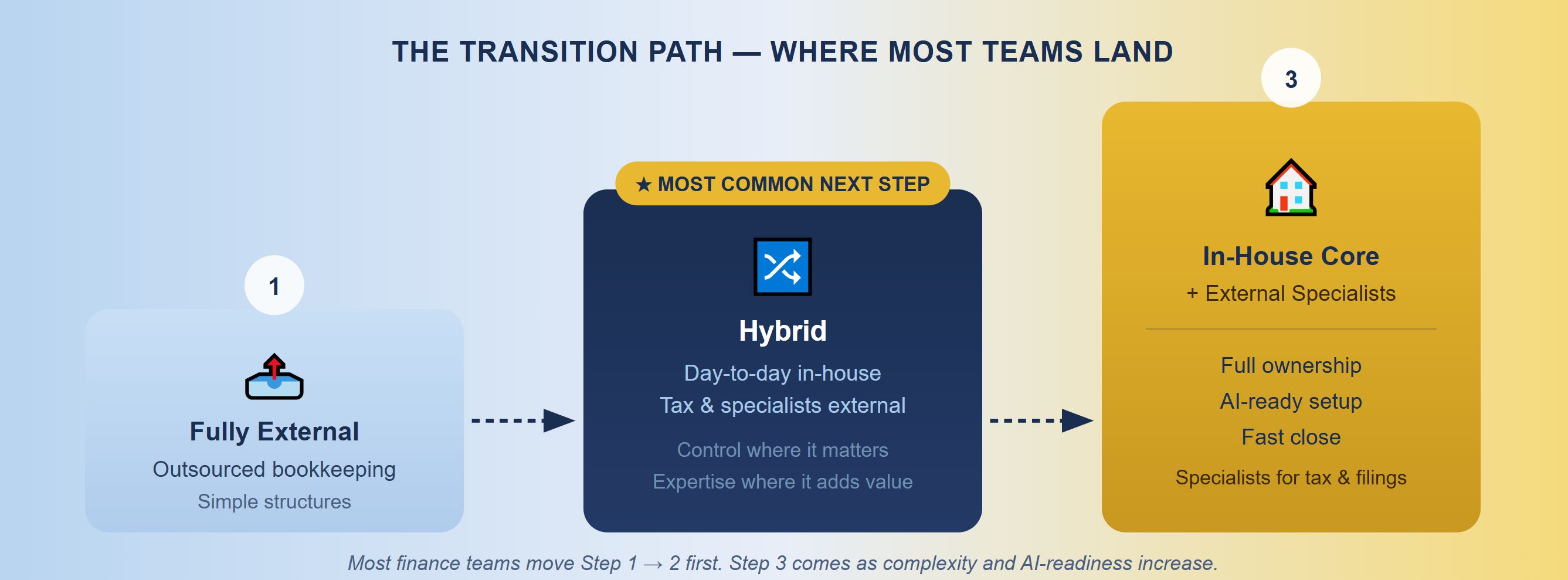
💡 Our view: once finance becomes a real operating layer, core accounting ownership belongs closer to the business. The hybrid model is how most teams get there without a clean break. |
4) What AI Is Changing - and What It Isn't
AI is already shifting this decision. The long-running case for external accounting was simple: buy expertise you do not need full-time. AI is making parts of that expertise available on demand - at a fraction of the cost.
Routine reconciliation, variance commentary, anomaly detection, journal drafting: increasingly automatable. That changes the economics of accounting headcount across the board.
But there is a catch.
AI works best where processes are clean, ownership is clear, and accounting logic sits close to the business. A fragmented external setup with manual exports and inconsistent coding will not be fixed by AI - it will fail faster.

This is an underappreciated argument for in-house or hybrid: a well-structured internal setup is far more AI-ready than a loosely managed external one.
Once finance becomes a steering function - not just a reporting function - control starts to matter more.
💡 AI is not an argument for keeping accounting external. It points toward tighter ownership - clean data, clear processes, and a setup where AI can actually be applied. |
5. The CFO Checklist: What to Do Before You Switch
Do not make this decision out of frustration. Pressure-test the setup first.
Ask these questions:
How many hours per month does the work actually require?
How complex are entities, countries, and intercompany flows?
How important are cost centers, project reporting, and fast close?
Who owns training, backup, and quality control today?
What is the real goal - lower cost, better quality, more control, or AI-readiness?
Dos
Define the real pain point first - separate provider failure from model failure
Quantify complexity, not just workload
Consider hybrid before going fully in-house
Review AI-readiness of your current setup alongside the operating model
Don'ts
Treat accounting as a commodity once complexity increases
Outsource accountability - someone must own the numbers
Delay a necessary change because switching feels disruptive
Assume in-house automatically fixes everything
💡 If accounting quality is affecting management reporting and trust in the numbers, this is no longer just an accounting topic. It is a finance operating model topic. |
Bottom Line
External accounting works well - until the business outgrows it.
As complexity and reporting expectations increase, CFOs keep arriving at the same point: they do not just need bookkeeping capacity. They need ownership.
That does not always mean a large internal team. But it almost always means bringing the core closer to the business - and using external specialists where they genuinely add value.
AI is accelerating this shift. The teams that benefit most will be the ones with clean processes and clear ownership - not the ones managing accounting at arm's length.
🔎 CFO Watchlist
Why Finance Hiring Is Getting Harder - Even When Roles Stay Open 60% of finance leaders say hiring is harder than in previous years. 41% say it takes three to six months to fill a role. But the deeper problem isn't the number of candidates - it's that the job has changed faster than the talent pipeline. 77% of CFOs now rank strategic thinking as the most important skill for the next generation of finance professionals. AI proficiency comes second. Technical accounting expertise? Seventh. The function is being asked to evolve faster than the people entering it are being trained.👉 Check out the full report here
Why Every CFO Should Read Amazon's 2025 Shareholder Letter - Andy Jassy doesn't write like a CEO protecting a stock price. He writes like someone who genuinely believes AI is the biggest inflection of his lifetime - and is spending $200 billion in a single year to prove it. AWS's AI revenue run rate hit $15 billion in Q1 2026. That is 260 times larger than all of AWS at the same point in its history. Read it not for the Amazon numbers, but for what it tells you about the pace and scale of what is coming. 👉 Amazon 2025 Shareholder Letter
🌐 Finance Collective
Where 170+ senior finance leaders exchange on what actually works
Join a curated network for:
| 
|
CLOSING REMARKS
Thanks for reading 💛
Send your feedback, suggestions, or requests to feature something in future editions to [email protected]. We’d love to include your input.
Follow us on LinkedIn for more updates!
CFO Playbook reflects our personal opinions, not professional advice.