- CFO Playbook
- Posts
- The Boardroom Playbook: How CFOs Turn Updates into Decisions
The Boardroom Playbook: How CFOs Turn Updates into Decisions


Simone Rüschenberg & Ellen Köhler
May 07, 2026

We’re Ellen and Simone. After 36 years in finance, we’re ready to share what textbooks won’t tell you.
💛 Welcome to CFO Playbook – your practical finance insights delivered bi-weekly. The full read will take approximately 5 minutes. Like what you see? Share it! Use the button below.
READ OF THE WEEK
Board meetings should be one of the highest-leverage moments in a company's operating rhythm.
In practice, they often drift into long status updates, crowded agendas and backward-looking detail. Everyone gets through the deck. But the real questions stay unresolved.
The CFO sits right in the middle - owning the numbers, seeing risks early, translating strategy into cash, runway, hiring capacity and capital allocation.
The real question is not: How do we make the board deck more polished?
It is: How do we turn board time into board value?
In this Read of the Week
1. Why board meetings lose their edge
2. The CFO's role: turning numbers into decisions
3. Board packs: from slide deck to Briefing Sheet
4. Before the meeting: align management first
5. Know the investor lens: VC, PE and the value creation plan
1. Why board meetings lose their edge
Most board meetings don't fail because people are unprepared. They fail because too much time goes to updates - and too little to judgment.
Revenue update. Hiring update. Product update. Finance update. Risk update.
All useful. But when every topic gets equal weight, the important questions get squeezed.
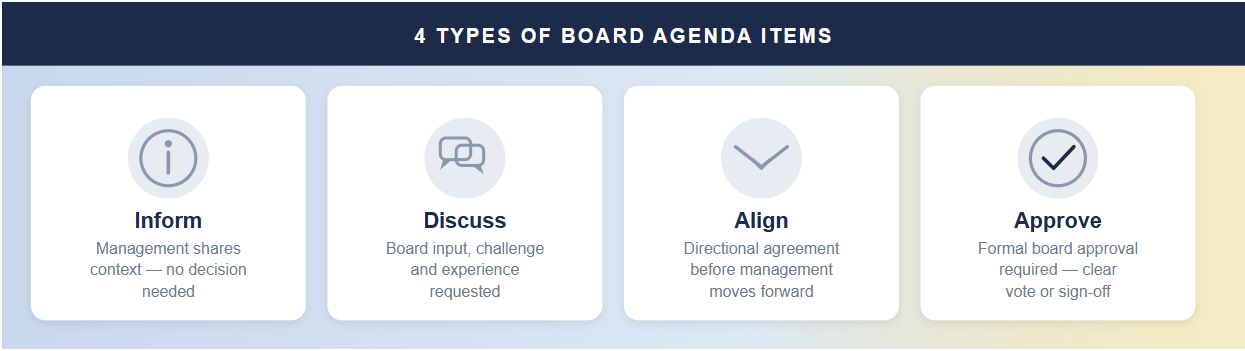
A strong board meeting separates four types of agenda items:
Inform – management shares context, no major discussion needed
Discuss – management wants input, challenge, or experience from the board
Align – management wants directional agreement before moving forward
Approve – formal board approval is required
Before each topic starts, state clearly what the intended outcome is.
Example: Cash runway update →Inform. No decision needed. Pricing model change →Align. Management wants directional input before a final call. Annual budget →Approve. Formal board approval requested. Expansion plan →Discuss. Management wants challenge on timing and capital requirements.
💡 If the board doesn't know whether it's being informed, consulted, aligned or asked to approve - the discussion will be slower than it needs to be.
There's a second failure mode worth flagging: not what's on the agenda, but what's missing from it.
AI is the clearest example today. If AI isn't on the board agenda at all, that's a warning sign. Every company has to navigate this transformation - and if the board can't have that discussion, the question isn't whether the topic belongs on the agenda. It's whether the right people are around the table.
2. The CFO's role: turning numbers into decisions
The CFO is often seen as the person who brings the numbers. That's necessary - but not enough.
A missed revenue target isn't just a variance. It may point to sales capacity, pricing pressure, weaker pipeline quality or a fundraising timing issue. A margin drop isn't just a finance topic - it can signal discounting, delivery inefficiency, or weak unit economics. A longer sales cycle isn't just a commercial update - it changes cash planning, hiring capacity and runway.
💡 The CFO's job is to connect these dots. Not with more slides. With better framing.
But framing only earns its weight when the foundation is solid.
If the board asks about a specific cohort, a regional margin or a deferred revenue assumption - and the CFO has to look it up or pass to someone else - credibility erodes fast.
Trust is built in the details. This matters in any setting, but in a PE context it's non-negotiable: the CFO is expected to be fluent in the underlying numbers, not just the headlines.
The board doesn't need every number. It needs the right interpretation:
What changed?
Which assumptions still hold?
Where is management confident - and where is the plan fragile?
What needs a decision?
💡 Finance should not just report what happened. Finance should frame what needs to happen next. |
3. Board packs: from slide deck to Briefing Sheet
A board pack should do two things: give the board consistent context and prepare it for the topics that need real discussion.
The standard reporting section should be boring - in a good way. Same structure every time. Same KPIs. Same definitions. Same view on revenue, margin, cash, runway, hiring and forecast vs. actuals. If every board pack looks different, the board spends too much time on format and too little on the business.
For strategic topics, use a Briefing Sheet - not another 15-slide section, not a long essay. A short decision document that helps the board understand the issue, pressure-test management's thinking, and move toward a clear outcome.
The Board Briefing Sheet:
Purpose & Board Ask - Inform, Discuss, Align, or Approve?
Background & Current Situation - What changed? What does the board need before discussing?
Key Considerations & Trade-offs - Options, risks, financial implications
Management Recommendation - What does management recommend, and why?
Milestones & Success Metrics - Who owns what, by when, and how will the board know if it worked?
Most board decisions are about trade-offs. Make them visible.
Example: Option A protects runway but slows growth. Option B accelerates growth but increases cash risk. Option C is the balanced case - but depends heavily on hiring execution.
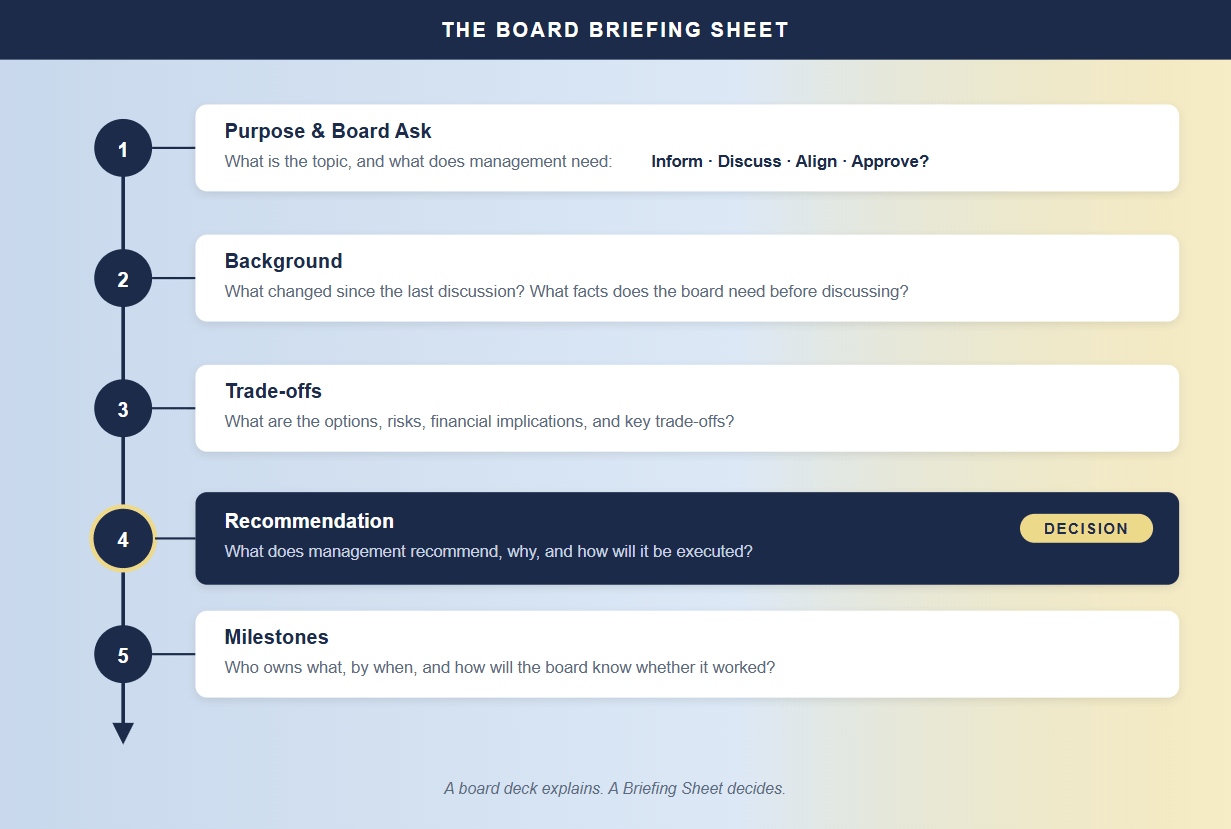
💡 A board deck explains. A Briefing Sheet decides. |
4) Before the meeting: align management first
Some board meetings go wrong before they even start - not because the topic is difficult, but because the groundwork wasn't done.
There are three layers of pre-work. CFOs often underestimate the last two.
1. Align the leadership team first. The board meeting is not the place for the C-level to surface internal disagreements - whether between CEO and CFO on runway, between CFO and CRO on pipeline quality, or between CEO and CTO on the AI roadmap. Internal debate is healthy - it should happen before the meeting, not during it.
The board needs a clear, consistent management position: the recommendation, the open questions, the trade-offs. Visible inconsistency between leadership figures undermines trust in the whole team - fast.
Before the meeting, the CFO should pressure-test:
Is the CEO aligned with the numbers and recommendation?
Have sensitive topics been discussed in advance?
Are we clear on what we need from the board - and what happens after?
2. Pre-align with the board. On big topics - fundraising, M&A, cost cuts, leadership changes - surprises in the boardroom rarely produce good decisions. The most effective CFOs have one-on-one conversations with the chair and key board members ahead of time. Walk them through the thinking. Hear their concerns early. By the time the topic hits the agenda, the discussion is already half-done.
3. Build trust outside the meeting. The CFO–board relationship doesn't only live in the boardroom. Lunches, dinners, coffees, board offsites - these are where real trust is built. When a difficult quarter comes, the board members who already know you and trust your judgement become your strongest allies. This is not a soft skill. It's an operating discipline.
💡 The better the alignment before the meeting - internally, with the board and beyond - the more useful the meeting becomes. |
5. Know the investor lens: VC, PE and the value creation plan
A board is not just a group of smart people around a table. Every investor is looking through a different lens - and that lens is shaped by two things: the type of investor they are and where they are in their fund cycle.
A VC optimizing for outlier returns thinks very differently from a PE investor focused on predictable margin expansion and exit readiness with balanced risk. Their risk profiles, return expectations and governance instincts are structurally different.
And timing compounds this further: a VC in year one of a new fund thinks very differently from one in year eight with limited follow-on capacity. A PE investor twelve months from a planned exit has different priorities than one who just closed the deal.
A VC may ask: Can this still become a venture-scale outcome? Should we reserve more capital for the next round? Does the company need to shift toward efficiency?
A PE investor may ask: Are we executing against the value creation plan? Are the margin levers coming through? Are systems and controls exit-ready? Where is the EBITDA upside?
A value creation plan is the investor's roadmap for increasing enterprise value during the ownership period - translating the investment thesis into concrete levers: revenue growth, margin expansion, pricing, working capital, M&A, systems, and exit readiness.
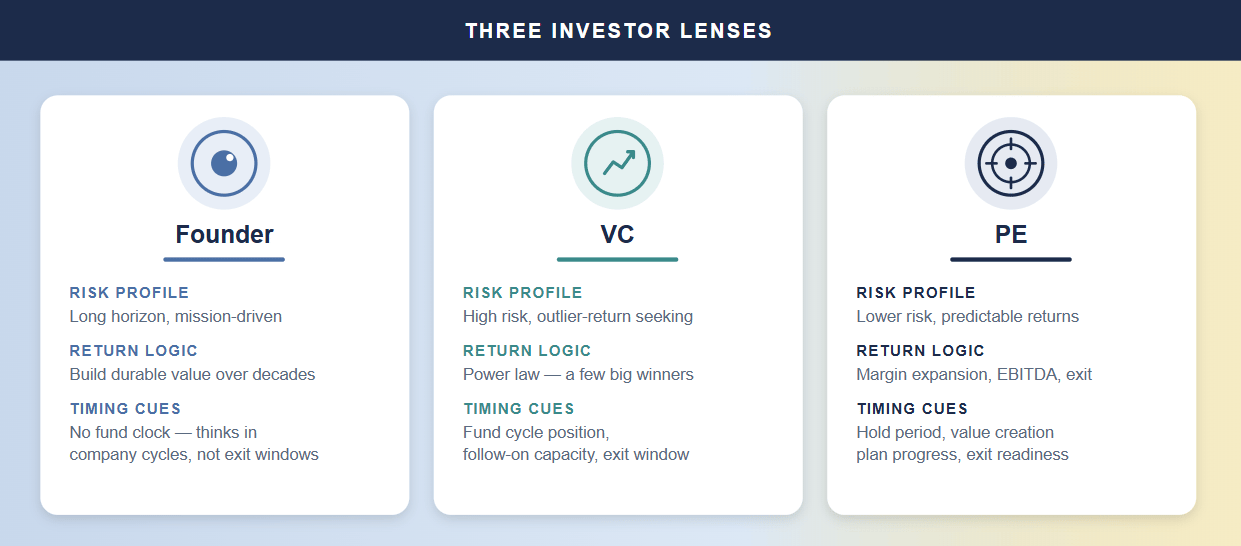
💡 You can't manage board dynamics if you don't understand the lens each investor is looking through - their risk profile, their return expectations and where they are in their own cycle. |
Bottom Line
Board meetings are only useful if they help the company make better decisions.
That doesn't happen through longer decks. It happens through sharper agendas, clear intended outcomes, better Briefing Sheets, early management alignment and proper follow-through.
For CFOs, the role is bigger than owning the numbers. The best board meetings create clarity. The best CFOs help make that happen.
🔎 CFO Watchlist
Anthropic launches ready-to-run AI agents for finance workflows
Anthropic is rolling out 10 agent templates for finance work, including financial modeling, valuation review, GL reconciliation, month-end close, statement checks, and KYC screening.
Why CFOs should care: This is where AI starts moving from “chatbot” to actual finance workflow execution. The most interesting use cases are not generic productivity tasks, but repeatable finance processes with clear inputs, controls, and review steps.
The finance AI race is shifting from prompts to packaged workflows. 👉 Want more details? Check the link here.
Microsoft adds Claude Opus 4.7 to Copilot
Microsoft is bringing Anthropic’s Claude Opus 4.7 to Microsoft 365 Copilot, starting with Copilot Cowork, Copilot Studio, and Excel.
Why CFOs should care: AI model choice is moving directly into the finance tech stack. Better reasoning, tool use, and spreadsheet support could make Copilot more useful for analysis, reporting, and finance workflows.
🌐 Finance Collective
Where 170+ senior finance leaders exchange on what actually works
Join a curated network for:
| 
|
CLOSING REMARKS
Thanks for reading 💛
Send your feedback, suggestions, or requests to feature something in future editions to [email protected]. We’d love to include your input.
Follow us on LinkedIn for more updates!
CFO Playbook reflects our personal opinions, not professional advice.